Thank you so much for visiting my blog page.
I created my new website 'Mari Wirth Papercut Art' (https://mariwirthpapercutart.com/).
Please visit my new website.
Or visit on
Facebook: Mari Wirth -TreeLeaf
Instagram: maritreeleaf
Twitter: @mari_treeleaf
I love wild plants and foraging. Roaming the meadows and woodlands is a big pleasure. In my blog I introduce my paper cut and print art work as well as seasonal countryside diary.
Showing posts with label From My Table. Show all posts
Tuesday, 17 July 2018
Sunday, 11 February 2018
The spring is coming! : New laser-cut limited edition of 4
The spring started last week, only on the calendar. But we can feel the light is getting brighter and longer day by day. I can hear birds singing outside from early in the morning. I can see buds on bare trees, still firm and small though. Plants and animals are already sensing the spring.
This is one of my 4 limited laser-cut paper cut works, same size as the original one. This is 27x27cm.
This paper is made with the rest produced through the bier brewery like hops, malt and cellulose. It is much thicker than the black paper, which was used for the original paper-cut.
Nature's Precious Project I
(Laser-cut from the original paper-cut) 27x27cm, Gmund Bier Bock paper 270gsm
This is one of my 4 limited laser-cut paper cut works, same size as the original one. This is 27x27cm.
This paper is made with the rest produced through the bier brewery like hops, malt and cellulose. It is much thicker than the black paper, which was used for the original paper-cut.
Nature's Precious Project I
(Laser-cut from the original paper-cut) 27x27cm, Gmund Bier Bock paper 270gsm
Thursday, 9 November 2017
Laser-cut paper artwork: new try
Last couple of years quite a few people asked and suggested that I should sell my original paper cut artworks. I have done before, and regretted that I'd sold. Then, I have looked for a laser-cut service near by my town. This Autumn, at last, I found one which does for custom made order, especially, for artists as well.
They have done excellent job; the laser-cut paper artworks are incredibly precise, but the difference is the thickness of the paper. I use rather thin paper to cut the intricate images. The laser-cut machine can cut the same job with much thicker paper. I chose 270gsm (90gsm black paper for my original paper cut). I can't cut such details with thick paper like this. Besides, the paper, which was used for the laser-cut, is eco-friendly. Chlorine free pulp is not surprising, but the paper is also made with spent brewer's grain. The team of the laser-cut studio told me that it smelled nicer when they cut the paper than usual paper.
The photo above is a 10x10cm small artwork, can be used as an Christmas ornament, or can be framed. The frame is double glazed and place a thin washi Japanese paper behind the lase-cut piece.
The one below is the larger one (28x28cm) but still not large. The original pieces are the same size.
Tuesday, 7 February 2017
A new papercutting plot: Spring
After the hectic time, my feeling is settled down to concentrate on new work.
My theme still sticks to wild life, fauna and flora, in the changing seasons. So, the upcoming work is 'spring' (a title is still not yet given, though).
It takes a while, until the draft for papercutting is done. This is (picture below) a part of the draft for 'spring'. Trace on a sheet of black paper, then start cutting.
Wednesday, 9 December 2015
Updated Portfolio!
The last craft market before Christmas was over last Sunday. Now, I have to gear up for the Christmas preparation. Alongside I am trying to update the portfolio (See above this window. There are salmon pink tool bars.) I have put part of the new pieces which I created for the solo exhibition in November in Japan.
Updated parts are:
Screen Prints: New!
and
Paper-Cut Art: UPDATED!
Please look at the difference between the original paper-cut artwork and the screen print. They give you quite different impression.
For expample;
Updated parts are:
Screen Prints: New!
and
Paper-Cut Art: UPDATED!
Please look at the difference between the original paper-cut artwork and the screen print. They give you quite different impression.
For expample;
Wednesday, 18 November 2015
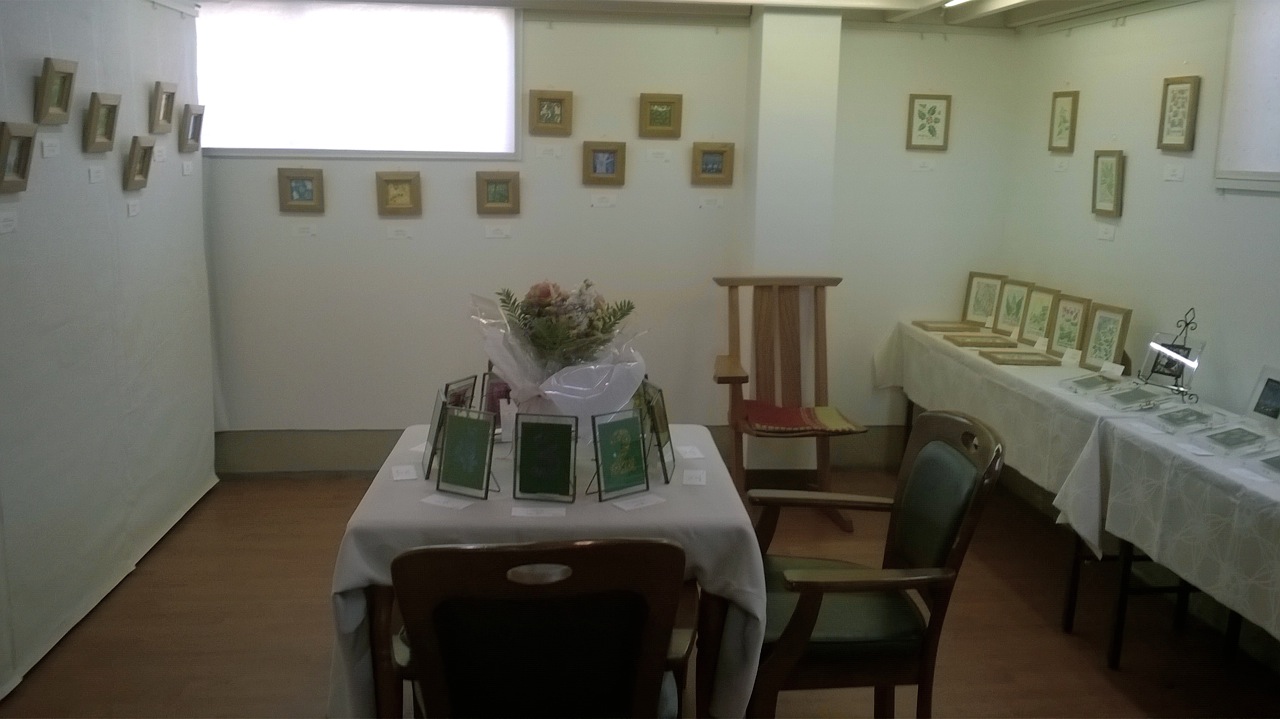
The Exhibition in Japan was over now
My first solo exhibition in Japan was over now. I've been back home in the UK and am thinking how wonderful it was. I would like to say thank you all who involved to the exhibition, no matter how involved, in the UK and in Japan and wherever!
The exhibition was held at moi (the website is written in Japanese) in Kakogawa (Hyogo prefecture, near by Himeji, western part of the main island) 4th - 8th November 2015.
I brought original paper-cut artwork, screen prints and relief prints for the exhibition.
It was a great nice surprise that a lot more people came to see my exhibition everyday than expected.
Displaying the original paper-cut artwork wasn't originally my idea but the owner of gallery moi. I'd like to thank her for giving me her invaluable suggestion! I added coloured opaque paraffin paper to the black paper artwork, which gave a very different impression to the screen print one.
For example,
Wednesday, 14 October 2015
'Garden Foraging' Back to the Nature: From a talk event of the Book Festival
'Garden Foraging', it was very tempting to me. It was the title of today's talk event of the Book Festival of our town.
The guest speakers were the author of 'The Garden Forager', Adele Nozedar, and a local artist and illustrator, Diana Mead.
I have one of Nozedar's book, 'The Hedgerow Handbook', which is one of my favourite plant books, from which I have often cited in this blog. I was looking forward to this event.
Yes, as expected, I (I suppose, everyone at the event as well) enjoyed it very much.
They brought an apple and a few branches of Himalayan honeysuckle from Diana Mead's garden. Nozedar said that about 90% of garden plants on the market (of the UK) were edible, even though it says 'not edible' (because of the marketing of traders).
Thinking about plants generally, it's difficult to distinguish between wild an cultivated ones. cultivated plants nowadays were, of course, cultivated from wild species. And vice versa, like Himalayan balsam and Japanese knotweed, both of which are edible and tasteful, they are categorised under unpleasant name, 'invasive plants'.
One of the audience questioned about the bitter taste of many of wild plants. Nozedar said the bitterness of those wild plants have been eliminated through cultivation to suite our (consumers') favour, but the component of the bitter taste has good effect on immune system and so on. We tend to prefer perfectly proportional spotless but less tasted fruits and vegetables from supermarkets.
She also told (in response to another question) that children in the two generation before (which means, grandparents as children) consumes much less sugar than children today.
I recall articles, many years ago, somewhere in a Japanese newspaper, that someone tried making dishes what the Tea Ceremony master or guru in the 16th century, Sen no Rikyu in those days. Unsurprisingly the tasters felt the dishes tasteless, which was meant to be little salted and spiced.
Our sense of taste (generally including other senses, actually) has been gradually weakened over the centuries.
Why not use those plants as healthy diet source and get our ancient sense back?
This is Himalayan honeysuckle in our garden. To be honest, I didn't know its name. Nozedar said it tasted like bitter sweet chocolate. After back home, I picked one of the berries and tasted it. Indeed! (An audience asked her if the leaves were also edible, and she immediately put a leave in her mouth! So, recommended young leaves rather than old autumnal leaves.)
The guest speakers were the author of 'The Garden Forager', Adele Nozedar, and a local artist and illustrator, Diana Mead.
I have one of Nozedar's book, 'The Hedgerow Handbook', which is one of my favourite plant books, from which I have often cited in this blog. I was looking forward to this event.
Yes, as expected, I (I suppose, everyone at the event as well) enjoyed it very much.
They brought an apple and a few branches of Himalayan honeysuckle from Diana Mead's garden. Nozedar said that about 90% of garden plants on the market (of the UK) were edible, even though it says 'not edible' (because of the marketing of traders).
Thinking about plants generally, it's difficult to distinguish between wild an cultivated ones. cultivated plants nowadays were, of course, cultivated from wild species. And vice versa, like Himalayan balsam and Japanese knotweed, both of which are edible and tasteful, they are categorised under unpleasant name, 'invasive plants'.
One of the audience questioned about the bitter taste of many of wild plants. Nozedar said the bitterness of those wild plants have been eliminated through cultivation to suite our (consumers') favour, but the component of the bitter taste has good effect on immune system and so on. We tend to prefer perfectly proportional spotless but less tasted fruits and vegetables from supermarkets.
She also told (in response to another question) that children in the two generation before (which means, grandparents as children) consumes much less sugar than children today.
I recall articles, many years ago, somewhere in a Japanese newspaper, that someone tried making dishes what the Tea Ceremony master or guru in the 16th century, Sen no Rikyu in those days. Unsurprisingly the tasters felt the dishes tasteless, which was meant to be little salted and spiced.
Our sense of taste (generally including other senses, actually) has been gradually weakened over the centuries.
Why not use those plants as healthy diet source and get our ancient sense back?
And, fuchsia in our garden as well. The flower are also edible despite the vivid neon colour.
In the end, I bought another foraging book of Nozedar, 'The Garden Forager'.
Monday, 16 June 2014
Illustration: Bento
This was the second time to display cabinets in the Cardiff Central Library (See on Facebook, Photos; Cardiff is the capital city of Wales, UK) for the Japan Day to raise awareness of Japanese Culture. This years Japan Day took place on Saturday 31st May.
I used to display cabinets in department stores and individual shops when I worked for a confectionary and cake company in Japan years ago. It was a sort of work, but 10 display cabinets at once! But my friends came to help me to do a lot on the day of display.
Many other friends supported for the display not only on the day of display, by such as creating Japanese calligraphy (amazing!), making origami art (amazing!) and lending invaluable personal belongings.
By the way, this time I drew some illustrations to decorate a couple of empty lunch boxes.
Bento, lunch box in Japanese, is a kind of food art, or a treasure box, filled with colourful foods. I cut the illustrations into the right sizes, fits to each lunch box.
I used to display cabinets in department stores and individual shops when I worked for a confectionary and cake company in Japan years ago. It was a sort of work, but 10 display cabinets at once! But my friends came to help me to do a lot on the day of display.
Many other friends supported for the display not only on the day of display, by such as creating Japanese calligraphy (amazing!), making origami art (amazing!) and lending invaluable personal belongings.
By the way, this time I drew some illustrations to decorate a couple of empty lunch boxes.
(Please see in Portfolio: Illustration)
Bento, lunch box in Japanese, is a kind of food art, or a treasure box, filled with colourful foods. I cut the illustrations into the right sizes, fits to each lunch box.
Nowadays in the UK, you can get a lot of Japanese ingredients in supermarkets, but I still miss the traditional lunch box which my mum used to make for her children every morning!
Wednesday, 8 January 2014
Story of my Calendars sent to Germany
Yesterday lovely photographs came through to me vial email from a cousin of my husband who lives in a Bavarian town, between Nuremberg and Munich, Germany. I was very delighted of her greeting message and the photos.
The beginning was just last month, in December 2013. She posted a message to me regarding my 2013 calendar, which was shown on this blog on 22.October 2013. Some of mothers, whose children as well as her child went to a kindergarten in Eichstätt of the State Bavaria, were interested in the calendar. She asked in the message if I could send some of them to her.
I was very interested in the kindergarten, which their children attended, and searched the website, Waldkindergarten. Would have been ideal for me when I was a small child! Children spend their precious time mostly in the nature. The name of the kindergarten, Spielraum Wald und Wiese, shows that children play and learn through the experience in the wonderful natural space including woodlands and meadows.
Waldkindergarten
photos: courtesy of the cousin and her husband
I wanted to contribute something towards running the kindergarten, and thought. Would it be a nice idea to send my calendars to Germany as a donation. I suggested the cousin that she could sell the calendar to those who were interested in and the money collected would go straight to the kindergarten.
So, I rushed into packing a small batch of calendars in a parcel and sent the parcel to her, having hoped that it would arrive there before Christmas broke up so that she had time to sell them as Christmas presents. Luckily she received the parcel in time and could collect the money. She wrote that the money would be used towards purchasing new materials, which sounded brilliant! The amount of my donation was small, though, I was glad that it helped a little bit for such a nice kindergarten. Thank you so much, cousin and her family, as well as those who are involved in the Waldkindergarten!
Wednesday, 13 March 2013
At last, put colour on
Having started in January, I've been still working on a print making. My target to finish off is by the end of this month. Otherwise the Easter rabbit won't come to me!
The painstaking work is engraving; no, parting a draft into different colour parts, for which I spend a lot of time. Engraving needs simply patience, care, and of course, time, but straightforward. Once everything done, I can enjoy the final colouring, or say, printing process. It is the most rewarding time during the whole printing process.
At last, I've started putting the first colour on paper yesterday. I bought a new hand-crafted baren (a rubbing disk to print the colour from a block) from Japan in December.
At the first try, how smooth, how light I could move on the paper! It was well worth to spend for that baren. I'm very happy with it.
I can put one colour on one day so that the colour on paper gets completely dry. Today I've put the second colour. It is always a thrilling moment if two colours can match well.
The painstaking work is engraving; no, parting a draft into different colour parts, for which I spend a lot of time. Engraving needs simply patience, care, and of course, time, but straightforward. Once everything done, I can enjoy the final colouring, or say, printing process. It is the most rewarding time during the whole printing process.
At last, I've started putting the first colour on paper yesterday. I bought a new hand-crafted baren (a rubbing disk to print the colour from a block) from Japan in December.
At the first try, how smooth, how light I could move on the paper! It was well worth to spend for that baren. I'm very happy with it.
I can put one colour on one day so that the colour on paper gets completely dry. Today I've put the second colour. It is always a thrilling moment if two colours can match well.
They are awaiting the next colour. Tomorrow the third colour comes onto them. Then the fourth colour comes the day after tomorrow, then the fifth the day after the day after tomorrow.... only if I can manage to carry on every day!
Subscribe to:
Posts (Atom)